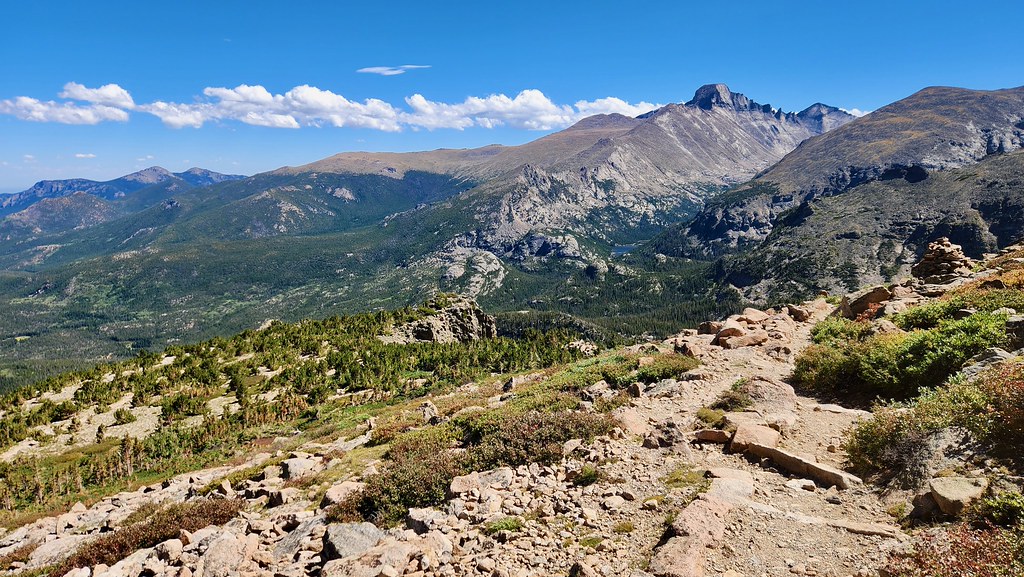
Quad Rock training week six

I ran four times, did one elliptical recovery spin on cold day, a recovery bike ride, one weight-lifting session, one yoga class, and the daily mobility and core workout six times.

  • 12 hours, 56 minutes all training

  • 27.2 miles running

  • 6,100 ft D+ running *

I put an asterisk by the elevation gain, because two-thirds of this was on a treadmill during interval workouts. There were no matching descents, and that's the toughest part of running in the mountains.

Running uphill is hard, but also relatively low impact. That's a win-win for my training. I'm doing almost all of my intense running right now at 10-12%, on a treadmill or steep road. In week six, I did 27 minutes of hard 30/30 running. Running on an 8% incline at an 11 minutes per mile pace felt more fun than going slower on a steeper setting. I'll do more of this.

I'm adjusting my Quad Rock training plan a bit to match my current fitness and race goals. Since I want to run the race faster and am responding well to the speed work that I am doing, I'm going to do more. Instead of four evenly sized four-week blocks of training, I'm switching to three blocks. A final block dedicated to improving my all-day pace isn't the best way to help me finish a 25 mile race in under five hours. Instead, the last block before the race will be devoted to zone 2-3 efforts and downhill running. I will also expand the length of my tempo run block from four to five weeks. In a nutshell: more speed, less slogging.

Quad Rock training week five

Unusually mild weather helped make week five productive. I can feel the benefits as I write this, a week later.

  • 11 hours, 37 minutes all training

  • 19.3 miles running

  • 1,890 ft D+ running

Tuesday I did hill sprints on the "Wallenberg Wall" in my neighborhood. My cadence has increased, and I was a second faster on average. 23 seconds instead of 24. Getting faster is one of my goals, and I'm making measurable progress.

Thursday I tried my first running intervals: 9 minutes at 9.5/10 rate of perceived exertion (RPE). This was on a road that starts at 5% incline and increases to 12%. To help keep the quality of the running intervals high, I'm practicing 30/30 running like I did last year, interleaving 30 seconds of maximum effort with 30 seconds of micro-recovery high effort. I ran by a utility crew on Centennial Drive and got some cheers and good-natured heckling for my effort.

Tuesday and Friday, I lifted weights at the gym. I'm doing 5 x 5 sets of back squats at the rack to build more muscle and increase the power of my legs. It's going well.

By Saturday, my legs need a bit of a break. I went for an easy ride with a few hard pushes, and gave the single track stretch of Timber trail a go. I can ride it cleanly on my mountain bike. It's more challenging on a gravel bike with no suspension and narrower tires.

https://live.staticflickr.com/65535/55108810041_585f27a1bf_b.jpg

A blue gravel bike laid across a sandy stretch of trail that becomes more rocky as it descends towards a reservoir under a blue Colorado sky.

Sunday, I did a long-ish run on the ridge east of Horsetooth Reservoir. "The reservoir", as we say here, though there are many reservoirs, because it's the biggest one. I went at the pace I'd like to run at Quad Rock, and felt good during the run and afterwards.

Quad Rock training week four

The numbers went up in week four.

  • 13 hours, 23 minutes all training

  • 30.2 miles running

  • 4,108 ft D+ running

More important is that I got in my power-building workouts. A big session of back squats and single-leg step-downs, among other exercises, at the gym on Tuesday after seeing my physical therapist. A session of hill sprints on Thursday after an easy run with a friend at Pineridge Open Space.

Saturday I went on another Quad Rock training run with a big crowd on an extraordinarily warm day. I'm glad I wore shorts and brought a third bottle of water. There were some icy spots early, but they'd melted on the return leg. I paid the price for going out too fast with some cramping at the finish, and struggled with knee stiffness, but mostly had a great morning.

Today, Sunday, I did an extended foam rolling, mobility, and core strength session while watching Liverpool lose to Manchester City in a chaotic finish. That initial goal by Szoboszlai was so good, I thought we were going to ride that to the finish. Nope. In the afternoon, after some gardening, I was loose enough to go for an easy run at Pineridge.

My long range plan has me switching from hill sprints to longer intervals next week. I think I'll smear this a little, with one session of hill sprints, and just one session of running intervals.

Quad Rock training week three

Week three had some good workouts and social running.

  • 12 hours, 9 minutes all training

  • 23.9 miles running

  • 3,268 ft D+ running

Yoga on Monday, as usual. Hill sprints Tuesday on a moderately steep dirt ramp at Pineridge Open Space. Elliptical spin and sets of back squats on Thursday. A long easy bike ride Friday.

Saturday, yesterday, I went for a long run in the snow at Horsetooth Mountain with friends. I kept it super easy until the last mile and a half, when I jumped onto a train of younger, faster runners who were coming down from a different route.

Today my legs felt great, and I took a new pair of NNormal Kjerags to the dry trails at Maxwell Open Space for a test drive. I think these could be my Quad Rock shoes. They're very light (my lightest trail shoes by 50 grams per shoe) and fit me well. I felt secure going quickly on rocky technical sections of the trails, where I did not in the Tecton X 3 that I wore last week.

My left hamstring feels 100 percent today, so I'm looking forward to two full sessions of hill sprints next week. I had some knee swelling early in the week, but it subsided before the week. My only pain point at the moment is an arthritis flare-up in my left shoulder. I'm taking ibuprofen at bedtime and hoping that it doesn't spread to my knees.

Quad Rock training weeks one and two

The first two weeks of my Quad Rock training program went by quickly. My running mileage is still low, as I'm emphasizing power and speed, with generous recovery, and biking, treadmill, or elliptical chuggingfor easy aerobic base building. The quality of my running workouts has been good, in a way that doesn't show up in these numbers.

In week one, I did hill sprint sessions on Tuesday and Thursday on a block of Wallenberg Drive with a 3-4% incline. Running up at nearly maximum effort took about 25 seconds. This was not an aerobic workout in any way. I was focused solely on power and turnover.

  • 11 hours, 7 minutes all training

  • 26.4 miles running

  • 1,545 ft D+ running

Week two was complicated by cold and snowy weather. I curtailed my hill sprints and did less dynamic workouts. Wednesday I did a two hour run at Lory State Park in a new pair of HOKA Tecton X 3 shoes. These were fun, and as propulsive as hyped on non-technical stretches of trail. I found them to be just barely stable on technical descents, however. The heel had a tendency to tip over. I'll give them another chance, for sure, but they are not an immediate choice for Quad Rock in May.

  • 12 hours, 41 minutes all training

  • 21.7 miles running

  • 2.464 ft D+ running

In October 2025, I started daily mobility and core strength sessions based on a post by Joe Uhan. I do a little Vinyasa flow, spinal twisting, some diagonal chops, and then push-ups, crunches or dead bugs, and eccentric heel drops and calf raises. I'm still doing this morning routine about six times a week, which accounts for almost three hours of my weekly training time. I've come from being able to do zero respectable pushups to being able to do sets of ten impeccable pushups. I'm a big person, 90 kilograms, so body weight pushups aren't super easy. It's been fun to make progress on basic strength and fitness.

Running in 2026: the plan

I've made my long range plan for 2026. It's different from my plans from 2023-2025, which were about recovering from injuries and trying to finish a 100 mile race. I succeeded in the former, but not in the latter.

In 2026 I am trying to be more intentional about training for speed. I'm going to do some workouts that develop power and neuromuscular adaptations, without any concern for building aerobic capacity during those workouts. I'm going to do more strides during longer runs and sign up for some shorter 5-10K races. I'm going to remind myself that running briefly, but regularly, at 100 percent can translate to running faster at 80-85 percent during a longer run.

That's my process goal. If I'm fortunate, I will reverse my recent slowing trend, and develop some relaxed, comfortable speed. Maybe I'll get a remarkable time in a race this year. Honestly, after three DNFs in a row (Bear 100 in 2023, Never Summer 100K and Bear 100 in 2025), just finishing would be nice. I haven't crossed a finish line since July 2023. It would be lovely to break this streak.

https://live.staticflickr.com/65535/55060846706_6f0fe37c2f_c.jpg

Screenshot of a Google spreadsheet. Each week from January through September is a column.

Like last year, I am mapping out my long range plan using a spreadsheet. I have signed up for two "A" races: Quad Rock 25-mile in May, and Run Rabbit Run 50-mile in September. Quad Rock I know very well. Run Rabbit Run, which starts at the base of Steamboat Mountain and goes up into the Park Range and back. It will be a new one for me.

Each race gets its own 16 weeks of training, organized into 4 blocks of 4 weeks. In the first block I focus on power and speed. The second is about longer hard intervals. The third is dedicated to longer zone 2 efforts. The fourth block is race-specific training: lots of time on hilly trails developing muscular endurance.

As part of my build up to RRR, I'd also like to do a classic Colorado alpine loop in August, like 4 Passes in the Maroon Bells Wilderness, or Pawnee-Buchananan in the Indian Peaks Range.

I've also marked down time for volunteering this year. I expect to help out at Never Summer and have signed up to be a volunteer at Hardrock. I'm also interested in crewing friends at races this year. Hit me up if you need an experienced hand, whether as a pacer or aid station crew.

Rasterio 1.5.0

Version 1.5.0 of your favorite Python library for reading and writing classic GIS raster data is on PyPI now. Since Jan 5, in fact.

Among other new features, this version adds support for 16-bit floating point raster data, and HTTP cache control. Please See the release notes for a full list of bug fixes, new features, and other changes.

Once again, major credit goes to Alan Snow for managing this release. Thanks, Alan!

Station Identification

Hello, my name is Sean Gillies, and this is my blog. I write about running, cooking and eating, gardening, travel, family, programming, Python, API design, geography, geographic data formats and protocols, open source, and internet standards. Mostly running and local geography. Fort Collins, Colorado, is my home. I work at TileDB, which sells a multimodal data platform for genomics and precision medicine. I appreciate emailed comments on my posts. You can find my address in the "about" page linked at the top of this page. Happy New Year!

https://live.staticflickr.com/65535/55036944705_bc496f45c8_c.jpg

Snow-covered cones, craters, and lava flows of Craters of the Moon National Monument in Idaho, viewed from an airliner traveling between Denver and Seattle on February 21, 2025.

Running in 2025

Running in 2025 started out badly, but I hung in there, rode my bike and chugged on the elliptical machine when I couldn't run, did a lot of physical therapy, and finally got into good enough shape that I could plausibly try the Bear 100 mile race again.

https://live.staticflickr.com/65535/54995674682_efdc72852a_b.jpg

Aspen, fir, and spruce trees bordering the Sinks area at the top of Logan Canyon. September, 2025.

I had little margin for error at the Bear, and misplayed my hand. I went out too fast and suffered for it after mile 35. I did manage to battle on for another 18 hours and 40 miles, and reached a new personal distance best. The best part of the whole event was the road trip with Ruthie, my crew chief, and staying with my aunt in Cache Valley before and after the run. And the fall colors. There were a lot of good parts. Crossing the finish line, sadly, was not one of them.

I did finally finish an ultra-distance run in November, a 32 mile trip from my home to the summit of Horsetooth Mountain, around the reservoir, and back. My house is behind my crazy hair in the photo below.

https://live.staticflickr.com/65535/54995674687_465a61ff36_b.jpg

Horsetooth Mountain from Herrington Trail. November, 2025.

https://live.staticflickr.com/65535/54996556586_66ba6214b0_c.jpg

Self portrait on the summit of Horsetooth Mountain. November, 2025.

In July I got to spend a weekend with my friends David and Marin at Never Summer, a great time. After the Bear I ran regularly with my local friend Dana as he was ramping up his running, and paced him during his DIY marathon. I did a day of trail work with local runners in May, and volunteering at Black Squirrel and Blue Sky Trail Marathon in September and October. I train alone, mostly, but I really do like to spend time outside with other runners.

My running numbers for the year:

  • 965 miles

  • 144,864 ft D+

  • 231 hours

That's less than two-thirds of my running volume for a good year. Things are looking up, however. I've been running and biking consistently after the Bear and am in good shape. I'm eager to get the 2026 season started. More about that soon.